In This Episode
- 0:01 Introduction and Overview
- 1:01 Engine Block Preparation
- 1:51 Crankshaft Installation
- 3:01 Camshaft Installation
- 4:04 Piston and Rod Assembly Installation
- 6:01 Sealing the Engine
- 7:50 Damper Installation
- 9:04 Head Installation
- 10:50 Valve Train Setup
- 12:04 Accessory Installation
- 13:42 Ignition System Setup
- 14:01 Oil Change
- 15:01 Engine Testing and Dyno Runs
Video Transcript
[Frankie] You're watching Powernation.
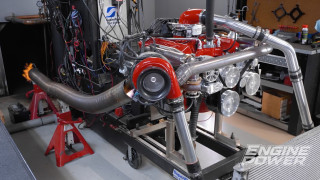
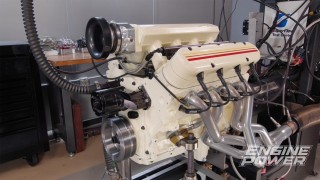
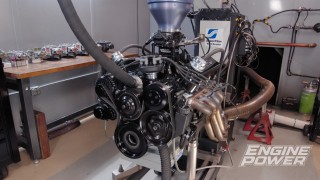
[Pat] We're wrapping up the assembly on our 363 inch small block Ford to get it fired up to make some big power on the dyno. [Frankie] High compression, a big hydraulic roller, and insanely good induction come together in a big bore short deck Ford. -All that and more today on Engine Power. [ Music ]
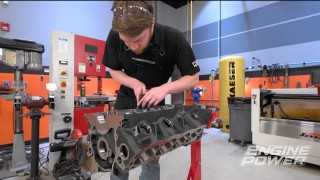
Hey there everyone and welcome to Engine Power. Today is going to be a really fun time because we're going to get our 363 cubic inch big bore small block Ford project put together and ran up on the lie detector. You know, our dyno. -Yeah, we have a ton of great parts going in this thing and everything has already been prepped. All the assembly work is pretty much what's left. All we have to do is get this thing together and start running it. So if you're not familiar with all the work it took to get this thing ready take a look at this. The base of this build is a Summit Racing SPC 302 based small block Ford engine block. After doing some light deburring and porting the oil passageways, we loaded it up into our Sunnen SV-15 to final hone the bores for proper size and surface finish. -The forged 3-400 stroke crankshaft was precision balanced to our other components in our CWT Industries balancer. And then with everything clean we set about checking our main bearing oil clearances. [ Music ]
After that, rod bearing clearances were also set so everything can be taped off and prepped for a beautiful gloss black paint job with POR-15 engine enamel. [ Music ]
-Diving right into assembly, our clean main bearings are laid into their positions and a new one piece remain seal is slid onto our crank. [ Music ]
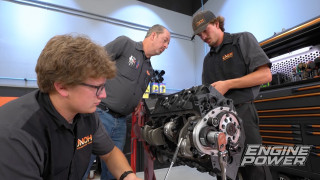
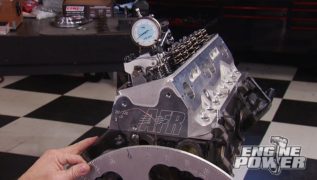
Some Hot Shot's Secret assembly lube creates a protective coating for our freshly polished crankshaft to be gently laid into place. All the main caps receive the same assembly lube and are carefully tapped into the registers before the bolts are threaded down. For this block the bolts are prepped with extreme pressure lube and the inners are torqued to 75 pound feet, while the splayed outers are torqued to 35 pound feet. [ impact driver humming ] -The thrust bearing faces were aligned before torquing, and we'll check the end play with a dial indicator. This street application calls for a hydraulic roller camshaft and this one is from Summit Racing's Pro SBF line. It has durations at 50 thousandths lift of 242 degrees on the intake and 256 degrees on the exhaust. The lobes are set on a 110 and a half lobe separation angle, and the lift at the valve with our rocker is 624 thousandths on both. -A matching thrust retainer plate is installed and the countersunk bolts are torqued to 150 pound inches with thread locker. This billet double roller timing set slides on next, and then we will install the number one piston and rod assembly in order to degree the camshaft. [ Music ]
Once our degree wheel indicator is set properly we can check the intake lobe center line and set it at 109 and an eighth. [ Music ]
-With the cam exactly where we want it we will reinstall the cam bolt with some orange thread retaining compound and torque it to 55 pound feet. [ Music ]
[ ratchet clicking ] We will prep the other rods and pistons for installation, and we are using a set of H-beam 5-400 long rods with an ARP 2000 bolt and a set of DSS Racing pistons for twisted wedge heads. These are for a 4-125 bore and have 5cc valve reliefs and a 1-090 compression height. They're made of 26-18 alloy. [ Music ]
These pistons come with an oil support rail for the three millimeter oil control ring, use a 1.2 Napier second ring with a 26 thousandths gap, and a steel 1.2mm top ring with a 24 thousandths gap. [ Music ]
With all of them complete they're ready to be punched in. Soon to come, our Ford reaches short block status and gets the bottom end sealed up for big induction.
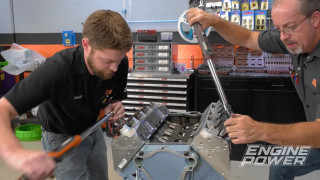
[Pat] Alright, we are looking great. Our 363 is all scienced out. All we have to do now is get the rest of our piston rod assemblies in and get this short block tuned up. [ Music ] Smooth. [Frankie] This ARP fixed ring compressor makes the installation a breeze and the ARP bolts can be snug down for now. Once all of the assemblies are installed in the block it can be flipped over and we can check each rod bolt for stretch. The bolts are loosened, our gauge can be zeroed out, and then they are torqued to 85 pound feet and measure again. Each bolt is set for the tolerance between 64 and 66 ten thousandths. [ Music ]
-To start sealing up the engine this precisely engineered timing cover from Holley can be installed as part of their front accessory drive that comes later. [ Music ]
A new high volume oil pump with a raised bypass pressure is set into place with an ARP driveshaft. Mounting bolts are tightened with thread locker, and then our front sump pickup can be slid over the ARP studs and is torqued in a similar manner to 25 pound feet. To prep for the oil pan thin beads of silicone are laid on the parting lines and on the curved gasket surfaces. We are using a Canton eight quart front sump pan with internal baffles, pickup tray, and crank scraper. It crushes a new one piece gasket with a set of stainless ARP oil pan studs that are tightened to the compression stops. -Since our 363 is a ground up fresh build we need a damper to go with it, and we immediately got a fluid damper coming on the way. If you're not familiar what this is. This is a viscous harmonic damper. So the way this works is unlike a traditional or OE style damper that uses an elastomer rubber band in between the inner and outer rings these have an inertia ring inside a cavity in the outer hub that is filled with a very thick, viscous fluid. What this does is dampen a wider range of harmonic frequencies than the elastomer style, and the benefit of it is it doesn't need to be rebuilt like an elastomer one. It can't degrade. As long as the fluid is inside of the damper it is functioning properly. So it's not only good for your engine but it's also a good investment. For our 363 we got an internal balance small block Ford damper. These have an inner hub and then the outer ring that uses the viscous fluid is bolted directly to it. These are also SFI approved. So if you want to go racing you can go racing with this and you'll be certified in everything. And it has multiple different timing marks depending on what small block Ford you're putting on and where you need your TDC mark to be. After installing it with a proper installation tool an ARP crank bolt can lock it down. -On the short deck Fords the lifters go in next, and for this build we are using a set of retrofit Comp cartridge style hydraulic roller lifters from Summit Racing. These head gaskets are Cometic's MLS with a 4-155 bore and a 27 thousandths compressed thickness. -Now we are to the point of talking about the induction that's going on this engine, which is pretty tricky, pun intended, because we're going to be running Trick Flow's brand new 227 11R cylinder head. This is a bad mamma jammer. It's the biggest one in their Twisted Wedge line. So the intake is on an 11 degree angle and the exhaust is on a 13 degree angle, and then they actually cant the valve slightly, the intake at five degrees, the exhaust at three. Our 227cc port flows 337 cfm at six hundred thousandths inch of lift on Trick Flow's bench and we flowed it on our SuperFlow 750 and it's right there cfm for cfm. Now it's doing all that through a 2-080 intake valve, and then it has a 1-600 exhaust valve, and these are housed in a 56cc tight combustion chamber. For valve train it is set up with a 1-275 dual spring with a titanium retainer and this is set up at around 160 pounds of seat pressure and 470 pounds of open pressure at our lift for our application. So these things are cleaned, put together, ready to go. All we have to do now is bolt on. Up next, our 363 gets dressed for success with sweet induction and blacked out accessories.
[Frankie] Continuing on, our TFS heads are set in place and this combo will have an 11.69 to 1 static compression ratio.
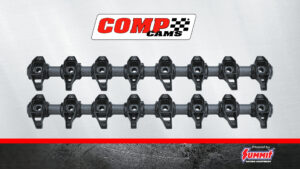
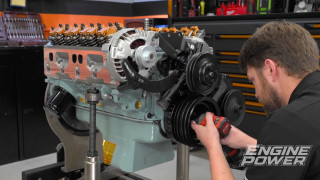
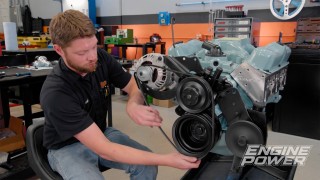
[Pat] For head bolts we're going to be using a set of brand new ARP fasteners specifically designed for our 302. If you know, like on a small block Ford, a 302 uses a seven-sixteenths fastener, like a Windsor, like a 351 uses a half inch. This kit contains a special hat washer that goes in the head bolt hole so you can use a seven-sixteenths bolt in a half inch hole in the cylinder head. So I'm going to get these prepped up. These are made out of 87-40 chromoly. They are a six point head, and they are around 180,000 psi of tensile strength. That means you have to follow ARP's specific instructions for torquing because this is not a stock fastener. So it does not take stock specs for torque. So we get it lubed up with some ARP Ultra Torque. A little under the head like that, and on the threads themselves. Remember, you don't want any lube under the hat washer because it can turn into a bearing surface and give you bad torque readings. All the hat washers are pressed into the head, and then the bolts can be slid in and started by hand. ARP fasteners have precision rolled threads for improved strength and accurate sizing. On this application the head bolt holes are blind. So no thread sealer is required. They just use ARP Ultra Torque, which has been painstakingly formulated to have consistent and repeatable clamp loads with each torquing. For this application the bolts are torqued in three stages from inside out starting at 30, 50, and then finally 70 pound feet. [Frankie] The rocker studs and guide plates that came with the heads are installed, properly aligned and torqued to 50 pound feet. Then the 7-100 long five-sixteenths push rods from Trick Flow receive high pressure lube and are slid into place. Each pair of these Comp Ultra Pro Magnum XD rocker arms are installed in the firing order at TDC compression stroke. This allows us to install a pair every 90 degrees of crankshaft rotation, and the hydraulic lifter's preload is set with one half turn past zero lash. -A new set of 45 thousandths thick intake gaskets are laid down along with beads of silicone on the China walls to make way for our port matched Trick Flow RSeries intake. After pre-lubing the valve train these color matched cast aluminum valve covers can go on to seal it up. -Back at the front of the engine we can bolt on this MSD crank trigger bracket that will ensure accurate timing at all rpm. After temporarily installing the trigger wheel to align the pickup, we can preset the timing to 29 degrees and lock the gap at 50 thousandths of an inch. Now the rest of our very nice Holley mid-mount accessory drive can be installed. This is designed as an all inclusive serpentine belt drive that is very compact for any swap. It comes with the water pump, power steering, alternator and A/C compressor in a sick blacked out look. We are going all out for the ignition system on our 363 with a complete MSD system. And as you saw earlier, we are running a crank trigger ignition system. So to go with that we have a complete set up on the table here. Starting out we have our crank trigger distributor. It comes fully locked out. So there's no mechanical advance or anything like that. It has a bronze gear, which is perfect for our steel billet camshaft, and it has a low profile large diameter cap. We have a full set of MSD superconductor wires that we're going to make for our Ford so we can make them nice and tidy and look exactly how we want. Then we also have a brand new HVC-2 coil in black to go with our black theme, and running everything is MSD's brand new Ultra-6ALPlus ignition box. This is really cool because this builds on the legacy of the 6AL but also allows you to fully program your ignition timing through the app or the software. It has an internal four bar map sensor you can plumb into your intake. It also has launch rpm, burnout rpm, a step retard. We'll get it mounted to the dyno so we can get this Ford running. -We'll get it up to temperature and make a few partial pulls to quickly break in this engine. [ engine revving ] We've got it all ran and everything is looking great. So now it's time for some fresh oil. Give it an oil change. We actually broke it in on this. This is Schaeffer's Supreme 7000 racing oil. What makes this oil unique? It has extra zinc in it for metal to metal protection. Normally you would use that in flat tappet cam applications, but that doesn't mean it doesn't work well for what we're doing. This oil also has great detergency. I know that sounds weird but that is also good if you're running it in a street engine. This is not just strictly race oil. We are using 10-W30 variety for our application. What we like about Schaeffers, it has excellent film strength and it is very resistant to thermal breakdown. Very important in both street and racing applications. So I'm going to get the plug popped here. Drain her out. Put our fresh stuff in. Geez, typical. The break-in oil is quickly drained and inspected for any sign of problems, and then a new filter can be spun on. [ Music ]
To get the proper oil levels seven quarts of new Supreme 7000 oil is dumped in to continue providing protection for when we start making big cylinder pressure. [ Music ]
We are ready to rock and roll. Time to burn some gas. Still on the way, Blacktop Speed Shop makes a stop to check out their new bullet making big steam.
[Frankie] We got our 363 running and back up to temp. After we did our oil change we got that break-in oil out. We did some preliminary testing, some light pulls and stuff like that. So now it is time to start actually doing some powerful start and actually ripping on this thing. We have brought the guys down from Blacktop Speed Shop, Brian and Jason, because this is your engine. Is it what you dreamed of? [Brian] It's amazing. Looks great, sounds great. I'm super pumped for this. [Jason] I'm excited. [Pat] You don't sound excited. [Frankie] Just excited, that's it? -He's getting there. -You guys wanted it all blacked out, right. We've got the murdered out theme going on. We've got a nice tight Holley mid mount accessory drive. You have all the accessories you need but they fit really good. Because this thing's going in a relatively small car, right? -It is. A '63 Ford Falcon project. It's just going to be a little rocket man. This is going to be amazing. -2,400 pounds, can't ask for more. -It's definitely going to be a rocket. First one we're going to make a low RPM pull. Just do a low sweep from 3,000 to 6,000. And we are at what for timing? -We are at 29 degrees of timing. -Ready? -Let's go. -I know you're ready. Here we go. [ engine revving ]
Oh wow. We have a 469 pound feet of torque right at 5,000, and it is climbing straight at 532.5 at 6,000. -469, that's pretty good. Right at 5,400, and this thing's already basically making 400 pound feet at 3,000. -First thing we're gonna do is step up the old RPM. -So we're going to go 4,500. That'll be right before peak torque and let's turn it 7,000. -Hydraulic roller, I doubt you're going to turn it over 7,000. It doesn't need to do that per se. I think it's going to be great. -All right, here we go. [ engine revving ]
-Wow, wow. -Very nice. -Oh man, that is pretty decent right there. -So we got a 577.8 right at 7,000. -And it basically repeated the torque. It's 468.5. -Having that nice wide door curve. You're going to be able to grab a gear in this thing anywhere basically above 3,000. -If you start at 424 pound feet of torque and you end at 433 pound feet of torque that's pretty awesome. -I can't get over how it sounds even at idle right now. [ engine revving ] -Oh yeah. -31, push that two and see what it does. -Just add two and we'll see what it does. This is a very efficient chamber in this thing with a flat top piston. -And we're relatively higher on compression. We have the new MSD Ultra Six ALPlus, which is their digital programable timing ignition box. You can actually program the timing on your phone based off map signal and RPM, and you can do a bunch of step retards or things like that. If you want to do a nitrous retard, or launch rpm, or something like that, super trick. -You don't need that. -Are you sure? -I'm 100 percent sure you do not need it. -My bone stock 350 really needs it. -Here we go. [ engine revving ]
-Smooth. That's 474 for torque, 579.5 for horsepower. -Yeah, but I mean it's not a huge gain. -Let's put one degree. Just because it made a little bit more there. Let's see what if one is going to level it off. What will happen is it might pick up a little bit power, might drop a little bit of torque. -So that's 32 there. -I'm so dumbfounded he can change that on his phone. That's just wild to me. -I'll let you do it on the next one okay. [ engine revving ]
-Look at that. 581.2 and it dropped a little bit of torque. It went 472.9. -That's a gain. -1.6! -One of the cool big numbers on pump gas horsepower per cubic inch stuff is 1.6. If you're making 1.6 on pump gas. -If you're making 1.5 per cube on pump gas you're doing good. -1.6 on pump gas, especially with a hydraulic roller, is very, very respectable. This is a solid combo. Hopefully this is everything you guys want. -If not we'll take it. -We can use it, I'm sure. -I'm pretty sure our little 2,400 pound machine is going to be tough to handle as it is. -We're not going to be able to keep tires on. -That is mean, mean, mean. -We're going to do our final checks on it and everything and then we'll get it off the dyno. And then we'll roll it down to your shop and you guys can stare at it for a little bit before you start working on it. -Thank y'all for doing this. Everything that we asked for. -We're setting the rev limiter to 7,000 for you. -I do like the limiter. -And for us great success! [ engine revving ]
Show Full Transcript
[Pat] We're wrapping up the assembly on our 363 inch small block Ford to get it fired up to make some big power on the dyno. [Frankie] High compression, a big hydraulic roller, and insanely good induction come together in a big bore short deck Ford. -All that and more today on Engine Power. [ Music ]
Hey there everyone and welcome to Engine Power. Today is going to be a really fun time because we're going to get our 363 cubic inch big bore small block Ford project put together and ran up on the lie detector. You know, our dyno. -Yeah, we have a ton of great parts going in this thing and everything has already been prepped. All the assembly work is pretty much what's left. All we have to do is get this thing together and start running it. So if you're not familiar with all the work it took to get this thing ready take a look at this. The base of this build is a Summit Racing SPC 302 based small block Ford engine block. After doing some light deburring and porting the oil passageways, we loaded it up into our Sunnen SV-15 to final hone the bores for proper size and surface finish. -The forged 3-400 stroke crankshaft was precision balanced to our other components in our CWT Industries balancer. And then with everything clean we set about checking our main bearing oil clearances. [ Music ]
After that, rod bearing clearances were also set so everything can be taped off and prepped for a beautiful gloss black paint job with POR-15 engine enamel. [ Music ]
-Diving right into assembly, our clean main bearings are laid into their positions and a new one piece remain seal is slid onto our crank. [ Music ]
Some Hot Shot's Secret assembly lube creates a protective coating for our freshly polished crankshaft to be gently laid into place. All the main caps receive the same assembly lube and are carefully tapped into the registers before the bolts are threaded down. For this block the bolts are prepped with extreme pressure lube and the inners are torqued to 75 pound feet, while the splayed outers are torqued to 35 pound feet. [ impact driver humming ] -The thrust bearing faces were aligned before torquing, and we'll check the end play with a dial indicator. This street application calls for a hydraulic roller camshaft and this one is from Summit Racing's Pro SBF line. It has durations at 50 thousandths lift of 242 degrees on the intake and 256 degrees on the exhaust. The lobes are set on a 110 and a half lobe separation angle, and the lift at the valve with our rocker is 624 thousandths on both. -A matching thrust retainer plate is installed and the countersunk bolts are torqued to 150 pound inches with thread locker. This billet double roller timing set slides on next, and then we will install the number one piston and rod assembly in order to degree the camshaft. [ Music ]
Once our degree wheel indicator is set properly we can check the intake lobe center line and set it at 109 and an eighth. [ Music ]
-With the cam exactly where we want it we will reinstall the cam bolt with some orange thread retaining compound and torque it to 55 pound feet. [ Music ]
[ ratchet clicking ] We will prep the other rods and pistons for installation, and we are using a set of H-beam 5-400 long rods with an ARP 2000 bolt and a set of DSS Racing pistons for twisted wedge heads. These are for a 4-125 bore and have 5cc valve reliefs and a 1-090 compression height. They're made of 26-18 alloy. [ Music ]
These pistons come with an oil support rail for the three millimeter oil control ring, use a 1.2 Napier second ring with a 26 thousandths gap, and a steel 1.2mm top ring with a 24 thousandths gap. [ Music ]
With all of them complete they're ready to be punched in. Soon to come, our Ford reaches short block status and gets the bottom end sealed up for big induction.
[Pat] Alright, we are looking great. Our 363 is all scienced out. All we have to do now is get the rest of our piston rod assemblies in and get this short block tuned up. [ Music ] Smooth. [Frankie] This ARP fixed ring compressor makes the installation a breeze and the ARP bolts can be snug down for now. Once all of the assemblies are installed in the block it can be flipped over and we can check each rod bolt for stretch. The bolts are loosened, our gauge can be zeroed out, and then they are torqued to 85 pound feet and measure again. Each bolt is set for the tolerance between 64 and 66 ten thousandths. [ Music ]
-To start sealing up the engine this precisely engineered timing cover from Holley can be installed as part of their front accessory drive that comes later. [ Music ]
A new high volume oil pump with a raised bypass pressure is set into place with an ARP driveshaft. Mounting bolts are tightened with thread locker, and then our front sump pickup can be slid over the ARP studs and is torqued in a similar manner to 25 pound feet. To prep for the oil pan thin beads of silicone are laid on the parting lines and on the curved gasket surfaces. We are using a Canton eight quart front sump pan with internal baffles, pickup tray, and crank scraper. It crushes a new one piece gasket with a set of stainless ARP oil pan studs that are tightened to the compression stops. -Since our 363 is a ground up fresh build we need a damper to go with it, and we immediately got a fluid damper coming on the way. If you're not familiar what this is. This is a viscous harmonic damper. So the way this works is unlike a traditional or OE style damper that uses an elastomer rubber band in between the inner and outer rings these have an inertia ring inside a cavity in the outer hub that is filled with a very thick, viscous fluid. What this does is dampen a wider range of harmonic frequencies than the elastomer style, and the benefit of it is it doesn't need to be rebuilt like an elastomer one. It can't degrade. As long as the fluid is inside of the damper it is functioning properly. So it's not only good for your engine but it's also a good investment. For our 363 we got an internal balance small block Ford damper. These have an inner hub and then the outer ring that uses the viscous fluid is bolted directly to it. These are also SFI approved. So if you want to go racing you can go racing with this and you'll be certified in everything. And it has multiple different timing marks depending on what small block Ford you're putting on and where you need your TDC mark to be. After installing it with a proper installation tool an ARP crank bolt can lock it down. -On the short deck Fords the lifters go in next, and for this build we are using a set of retrofit Comp cartridge style hydraulic roller lifters from Summit Racing. These head gaskets are Cometic's MLS with a 4-155 bore and a 27 thousandths compressed thickness. -Now we are to the point of talking about the induction that's going on this engine, which is pretty tricky, pun intended, because we're going to be running Trick Flow's brand new 227 11R cylinder head. This is a bad mamma jammer. It's the biggest one in their Twisted Wedge line. So the intake is on an 11 degree angle and the exhaust is on a 13 degree angle, and then they actually cant the valve slightly, the intake at five degrees, the exhaust at three. Our 227cc port flows 337 cfm at six hundred thousandths inch of lift on Trick Flow's bench and we flowed it on our SuperFlow 750 and it's right there cfm for cfm. Now it's doing all that through a 2-080 intake valve, and then it has a 1-600 exhaust valve, and these are housed in a 56cc tight combustion chamber. For valve train it is set up with a 1-275 dual spring with a titanium retainer and this is set up at around 160 pounds of seat pressure and 470 pounds of open pressure at our lift for our application. So these things are cleaned, put together, ready to go. All we have to do now is bolt on. Up next, our 363 gets dressed for success with sweet induction and blacked out accessories.
[Frankie] Continuing on, our TFS heads are set in place and this combo will have an 11.69 to 1 static compression ratio.
[Pat] For head bolts we're going to be using a set of brand new ARP fasteners specifically designed for our 302. If you know, like on a small block Ford, a 302 uses a seven-sixteenths fastener, like a Windsor, like a 351 uses a half inch. This kit contains a special hat washer that goes in the head bolt hole so you can use a seven-sixteenths bolt in a half inch hole in the cylinder head. So I'm going to get these prepped up. These are made out of 87-40 chromoly. They are a six point head, and they are around 180,000 psi of tensile strength. That means you have to follow ARP's specific instructions for torquing because this is not a stock fastener. So it does not take stock specs for torque. So we get it lubed up with some ARP Ultra Torque. A little under the head like that, and on the threads themselves. Remember, you don't want any lube under the hat washer because it can turn into a bearing surface and give you bad torque readings. All the hat washers are pressed into the head, and then the bolts can be slid in and started by hand. ARP fasteners have precision rolled threads for improved strength and accurate sizing. On this application the head bolt holes are blind. So no thread sealer is required. They just use ARP Ultra Torque, which has been painstakingly formulated to have consistent and repeatable clamp loads with each torquing. For this application the bolts are torqued in three stages from inside out starting at 30, 50, and then finally 70 pound feet. [Frankie] The rocker studs and guide plates that came with the heads are installed, properly aligned and torqued to 50 pound feet. Then the 7-100 long five-sixteenths push rods from Trick Flow receive high pressure lube and are slid into place. Each pair of these Comp Ultra Pro Magnum XD rocker arms are installed in the firing order at TDC compression stroke. This allows us to install a pair every 90 degrees of crankshaft rotation, and the hydraulic lifter's preload is set with one half turn past zero lash. -A new set of 45 thousandths thick intake gaskets are laid down along with beads of silicone on the China walls to make way for our port matched Trick Flow RSeries intake. After pre-lubing the valve train these color matched cast aluminum valve covers can go on to seal it up. -Back at the front of the engine we can bolt on this MSD crank trigger bracket that will ensure accurate timing at all rpm. After temporarily installing the trigger wheel to align the pickup, we can preset the timing to 29 degrees and lock the gap at 50 thousandths of an inch. Now the rest of our very nice Holley mid-mount accessory drive can be installed. This is designed as an all inclusive serpentine belt drive that is very compact for any swap. It comes with the water pump, power steering, alternator and A/C compressor in a sick blacked out look. We are going all out for the ignition system on our 363 with a complete MSD system. And as you saw earlier, we are running a crank trigger ignition system. So to go with that we have a complete set up on the table here. Starting out we have our crank trigger distributor. It comes fully locked out. So there's no mechanical advance or anything like that. It has a bronze gear, which is perfect for our steel billet camshaft, and it has a low profile large diameter cap. We have a full set of MSD superconductor wires that we're going to make for our Ford so we can make them nice and tidy and look exactly how we want. Then we also have a brand new HVC-2 coil in black to go with our black theme, and running everything is MSD's brand new Ultra-6ALPlus ignition box. This is really cool because this builds on the legacy of the 6AL but also allows you to fully program your ignition timing through the app or the software. It has an internal four bar map sensor you can plumb into your intake. It also has launch rpm, burnout rpm, a step retard. We'll get it mounted to the dyno so we can get this Ford running. -We'll get it up to temperature and make a few partial pulls to quickly break in this engine. [ engine revving ] We've got it all ran and everything is looking great. So now it's time for some fresh oil. Give it an oil change. We actually broke it in on this. This is Schaeffer's Supreme 7000 racing oil. What makes this oil unique? It has extra zinc in it for metal to metal protection. Normally you would use that in flat tappet cam applications, but that doesn't mean it doesn't work well for what we're doing. This oil also has great detergency. I know that sounds weird but that is also good if you're running it in a street engine. This is not just strictly race oil. We are using 10-W30 variety for our application. What we like about Schaeffers, it has excellent film strength and it is very resistant to thermal breakdown. Very important in both street and racing applications. So I'm going to get the plug popped here. Drain her out. Put our fresh stuff in. Geez, typical. The break-in oil is quickly drained and inspected for any sign of problems, and then a new filter can be spun on. [ Music ]
To get the proper oil levels seven quarts of new Supreme 7000 oil is dumped in to continue providing protection for when we start making big cylinder pressure. [ Music ]
We are ready to rock and roll. Time to burn some gas. Still on the way, Blacktop Speed Shop makes a stop to check out their new bullet making big steam.
[Frankie] We got our 363 running and back up to temp. After we did our oil change we got that break-in oil out. We did some preliminary testing, some light pulls and stuff like that. So now it is time to start actually doing some powerful start and actually ripping on this thing. We have brought the guys down from Blacktop Speed Shop, Brian and Jason, because this is your engine. Is it what you dreamed of? [Brian] It's amazing. Looks great, sounds great. I'm super pumped for this. [Jason] I'm excited. [Pat] You don't sound excited. [Frankie] Just excited, that's it? -He's getting there. -You guys wanted it all blacked out, right. We've got the murdered out theme going on. We've got a nice tight Holley mid mount accessory drive. You have all the accessories you need but they fit really good. Because this thing's going in a relatively small car, right? -It is. A '63 Ford Falcon project. It's just going to be a little rocket man. This is going to be amazing. -2,400 pounds, can't ask for more. -It's definitely going to be a rocket. First one we're going to make a low RPM pull. Just do a low sweep from 3,000 to 6,000. And we are at what for timing? -We are at 29 degrees of timing. -Ready? -Let's go. -I know you're ready. Here we go. [ engine revving ]
Oh wow. We have a 469 pound feet of torque right at 5,000, and it is climbing straight at 532.5 at 6,000. -469, that's pretty good. Right at 5,400, and this thing's already basically making 400 pound feet at 3,000. -First thing we're gonna do is step up the old RPM. -So we're going to go 4,500. That'll be right before peak torque and let's turn it 7,000. -Hydraulic roller, I doubt you're going to turn it over 7,000. It doesn't need to do that per se. I think it's going to be great. -All right, here we go. [ engine revving ]
-Wow, wow. -Very nice. -Oh man, that is pretty decent right there. -So we got a 577.8 right at 7,000. -And it basically repeated the torque. It's 468.5. -Having that nice wide door curve. You're going to be able to grab a gear in this thing anywhere basically above 3,000. -If you start at 424 pound feet of torque and you end at 433 pound feet of torque that's pretty awesome. -I can't get over how it sounds even at idle right now. [ engine revving ] -Oh yeah. -31, push that two and see what it does. -Just add two and we'll see what it does. This is a very efficient chamber in this thing with a flat top piston. -And we're relatively higher on compression. We have the new MSD Ultra Six ALPlus, which is their digital programable timing ignition box. You can actually program the timing on your phone based off map signal and RPM, and you can do a bunch of step retards or things like that. If you want to do a nitrous retard, or launch rpm, or something like that, super trick. -You don't need that. -Are you sure? -I'm 100 percent sure you do not need it. -My bone stock 350 really needs it. -Here we go. [ engine revving ]
-Smooth. That's 474 for torque, 579.5 for horsepower. -Yeah, but I mean it's not a huge gain. -Let's put one degree. Just because it made a little bit more there. Let's see what if one is going to level it off. What will happen is it might pick up a little bit power, might drop a little bit of torque. -So that's 32 there. -I'm so dumbfounded he can change that on his phone. That's just wild to me. -I'll let you do it on the next one okay. [ engine revving ]
-Look at that. 581.2 and it dropped a little bit of torque. It went 472.9. -That's a gain. -1.6! -One of the cool big numbers on pump gas horsepower per cubic inch stuff is 1.6. If you're making 1.6 on pump gas. -If you're making 1.5 per cube on pump gas you're doing good. -1.6 on pump gas, especially with a hydraulic roller, is very, very respectable. This is a solid combo. Hopefully this is everything you guys want. -If not we'll take it. -We can use it, I'm sure. -I'm pretty sure our little 2,400 pound machine is going to be tough to handle as it is. -We're not going to be able to keep tires on. -That is mean, mean, mean. -We're going to do our final checks on it and everything and then we'll get it off the dyno. And then we'll roll it down to your shop and you guys can stare at it for a little bit before you start working on it. -Thank y'all for doing this. Everything that we asked for. -We're setting the rev limiter to 7,000 for you. -I do like the limiter. -And for us great success! [ engine revving ]
Engine Power Featured Projects
Engine Power Builds



Want more content like this?
Join the PowerNation Email NewsletterParts Used In This Episode


Schaeffer Specialized Lubricants
Schaeffer's Supreme 7000 Synthetic Plus Racing Oil 10W-30

Summit Racing
Trick Flow Twisted Wedge 11R 227 Cylinder Heads for Small Block Ford
Summit Racing
Summit Racing Pro SBF and 303+ Hydraulic Roller Camshaft
Summit Racing
Trick Flow R-Series 11R 227 Port-Matched Carbureted Intake Manifold