

In This Episode
- 0:01 Introduction to the project
- 1:05 Overview of the Ford Falcon Futura
- 1:57 Installing the clutch and flywheel
- 4:09 Installing the bolts and Teflon tape
- 5:27 Installing the transmission
- 10:01 Painting the engine bay
- 12:01 Installing the engine and transmission
- 13:37 Issues with installation and change of plans
- 15:32 Final installation and starting the engine
Video Transcript
You are watching Power Nation.
If I'm on fire, there's a big problem.
Today on Blacktop Speed Shop,
we're finishing up our transmission and getting everything hooked up so we could try and run our 363 small block
and our Ford Falcon Futura.
Oh yeah, this is gonna be great. I could see this already.
This engine and trans may not fit in this Ford,
but with a little bit of elbow grease and some luck,
we may just be able to make it work.
Can we get everything dropped in so we can finally say we gained over 500 horsepower?
This is our 1963 Ford Falcon Futura.
When we pulled it in the shop,
it was in such good condition
you'd think this bird could fly,
but a quick look under the hood revealed that this was never going to be fast enough to lift off.
With a tiny 144 inline six,
we wanted to see what it would run on the dyno and if it was indeed the weakest engine if we've ever pulled.
Yeah,
47.29,
79.5 pound feet.
We tried to free up some horsepower,
but somebody decided to make it
too free.
Hey,
uh,
that's what I was gonna tell you.
So we added
500+ horse
with a 363 small block and gave this Falcon a real set of wings.
That's a whole lot of motor for a small car.
That's a huge motor.
I guess we could lower the car down some more
and put this block under the front of it.
How far can we go before the control arms set?
Maybe 3 or 4 inches.
Squeezing all that power under the hood wasn't easy, but we got it to fit, and today this engine is gonna run.
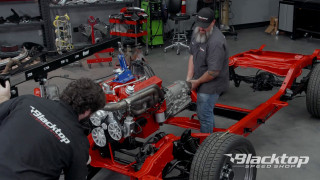
The next step to moving forward with our Falcon is putting the engine back in.
In order to do that, we have to install the clutch so we can put the trans on it,
get the drivetrain mocked up,
and get it ready.
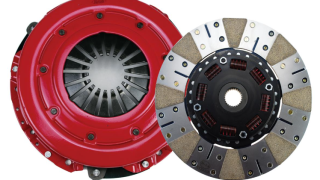
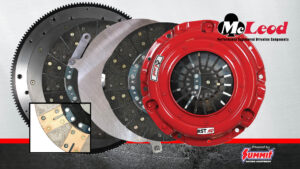
So the biggest difference between these two is that this is a twin disc and this is a single disc.
Twin discs are great when you need
twin disc clamping,
but we don't need that because we're not drag racing. The car's not heavy.
So we went with a single disc aluminum flywheel
to reduce weight
and to make it simpler.
Also,
single discs are a little bit cheaper as well.
The biggest downfall
with this is that
the single discs are a metallic puck style where the twin disc is an organic fiber style which has a little more give to it than these,
so.
This clutch is gonna feel more like an on-off switch than the twin disc,
but
this is a lot lighter and a lot better for spirited street driving,
if you will,
than it is for a twin disc.
But since for this application we don't make the torque and we don't have a super heavy car, we're gonna stick with a single disc
and we're gonna use an aluminum flywheel.
So
this is what we're gonna go with.
Oh.
Big mistake number one, don't forget this.
I totally haven't forgotten this already, I promise
this is.
This is all part of the plan.
This is for manual transmissions. If you don't have this on,
the bottom of this is wide open.
You can get dirt, debris,
your fingers stuck in it while the flywheel's spinning.
That's not good.
We're using this aluminum flywheel that we got from SummitRacing.
Your flywheel here,
one of these bolts will be spaced differently from the rest of them,
so if you put it on and something's not lining up,
don't freak out,
just spin it a couple of times, it'll line up, I promise.
Now that I got the flywheel sitting up here,
we have to install the bolts, and this is your Summit Tech tip.
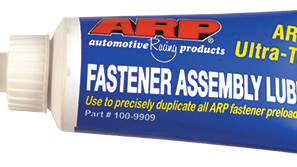
Before you install the bolts, you have to put Teflon tape
and you have to put ARP lube under the head of the bolt.
So I'm gonna get this one screwed in for you and I'm gonna show you how to do that on the last one here.
Super simple, super easy, but it is necessary.
When you Teflon a bolt,
it's directional,
so you wanna lay it on,
it's gonna feel backwards at first
and you just roll it onto the bolt.
You don't need a lot,
just a couple layers.
Enough so that oil can't get through.
And leak out of your bolts, and then you just.
Rip it off
And then the loose end
here
goes with the threads
so that when you tighten it,
it just tightens it down onto the threads more, it doesn't roll it up,
doesn't ruin anything.
That's a good way to test it if you did it the right way or not.
Just hold your finger on it, screw it like you're tightening,
righty tighty,
and nothing balls up.
You did it right.
Before you do install the bolt, you have to put a little lube under
the head of the bolt.
The bolt should go in smooth
You just want to get them started.
These bolts
go into an oil gallery in the back of the crank,
so if you don't seal the ends of the threads,
it'll leak oil out from right here.
And if you get oil on your friction surface, your clutch will slive, you junk everything,
not good.
So
seal it up good.
Boom, it's broken.
It's gone.
In a star pattern.
You're a star in my eyes.
One.
2.
3.
Or
I
6,
hooray.
Am I done now, sir?
Yeah.
You are done,
sir.
Thank you.
Would you like for me to go fetch you some brake clean,
please? I'll be in my trailer.
I have to go next door because we're out.
Up next
we finished mounting the transmission
and we're gonna see if this TKX is gonna fit.
Now that we've got the flywheel installed, I got the bell housing put on, I got the clutch put on,
we're getting ready to make up our transmission.
Before you put your transmission in,
you have to measure and make sure your spacing for your throw-out bearing is correct.
When you buy a trans from American Powertrain, they send you pretty in-depth instructions. I'm gonna kind of gloss over this and give you some
general information on when you're doing this.
But
it's pretty simple, it's pretty straightforward.
It's nothing hard.
With the instructions for American Powertrains TKX, it tells you
the shim spacing for your throwout bearing. It tells you what each one is, it tells you the math equation you gotta use, which you just subtract your numbers. It's nothing crazy.
You want to get at least 3 measurements to get a median, that way you can have an average
in case one finger is different from another one.
Same thing with your throw-out bearing.
You measure from the face of the throwout bearing
to the face of the transmission itself.
You do 3 measurements in 3 different places to get a median.
When you get those,
American Powertrain tells you
to take
the one from the transmission
and subtract it from the one from the bell housing.
They even give you
an example
to help you.
American powertrains spec for the air gap
is no less than 100,000 and no more than 200,000. They say they want it at about 150,000 of an inch.
Our math,
which I have
wrote down
right here,
came out to 151,000 with 4 of their shims.
Each of their shims is 57,000 thick, which they put in here.
This is what it looks like.
Since we're putting this in a Ford,
we ordered a Ford throw hydraulic throwout bearing kit. They call it the,
the Hydromax throwout bearing kit from American Powertrain. That's for a Ford.
So when you get your measurements for your clutch to your bell housing and from the trans to your throwout bearing, you got to subtract them and that gives you a number.
Ours was 379,000.
American Powertrain tells you to subtract the.
Thickness of your shim
as many times as it takes to get between 100,000
and 200,000.
For us that was 4, and that left us with 151,000 of an inch for air gap,
which is right in the middle of the spec where they want it.
But now that we're in spec
and we're getting ready to put it in the car,
I need
Brian
to come help me make these two together and we'll go drop it in the car and
Maybe start it.
Hopefully,
if Dad lets me,
we'll start a.
Make sure you pull your alignment tool before you try to put the input shaft in though
it's a good rule of thumb.
That probably wouldn't work very well,
no.
Man, I wish they made like a, a jack for this.
What they say like a bull in a china shop
or a long-tailed cat in a room full of rocking chairs.
Do Southerners say anything that makes sense?
Hold on,
I'll put this bowl in, Jackson.
So it should already be lined up.
Look at that, dude.
Well, we got a problem.
No pressure.
What's the problem is if it's not
lined up right now and it's sitting in there like that,
we have a problem.
Should we put thread locker on this?
I did in the bell housing. I don't know about these.
Guess we can
later.
Later,
later,
when it comes off,
that'll happen
100%. That'll happen. I think it'll be just fine without it, dude.
What's the torch spec, you know.
That much that much sounds good.
I figured aluminum to aluminum would be 45.
Or I just ruined it and it's gonna blow up now it's gonna explode,
it's gonna spontaneously combust because I over torqued it.
So this is
a thing of beauty,
yeah,
because it's a 5 speed and it's complete,
not a slush box
as much as we can complete it up to this point.
So while we had the engine and transmission already out of our Ford Falcon,
we wanted to dress up the engine bay as much as we could.
Uh, we really thought about leaving the traditional black like.
Most cars come from the factory,
but we wanted something a little different.
So
interior on our car is Ford Rangoon red, which is a common color for a sixties model Ford.
So we wanted to dress it up and we painted the engine bay that color.
Couple things to note though with that color.
Uh,
the inside of the vehicle is all red, red dash carpet seats,
door panels,
everything,
and the windows are currently tinted on this car as well,
so it makes the red look more dark than what it really is once the door opens.
So I did a spray out panel,
some scrap metal that we had around the shop.
The red is still gonna be red, but you could change the lightness or darkness of the color
by the base.
You put it over
so
this side
right is the white side,
this side is the gray side, and there's a black strip that's separating it down the middle.
Well now our paint's in
everything is dry,
everything is cured, um, now we're ready to sit the engine and transmission in it, but
we gotta be extremely careful not to scratch and tear up our brand new paint job in here,
so it's gonna be a task for two people for sure.
Hold on, we're,
we're slipping,
careful,
that leg just lifted a little bit.
All right, hold it right there,
Kemosabe.
It's like wasabi but different.
Oh yeah, this is gonna be great. I can see this already.
All right,
stop right there.
Can you start to let it down a little bit,
keep going.
I wonder how much fluid's gonna leak out of this transmission if I pull this yoke out.
Probably a lot.
I'm just giving the action cam
a bath.
Oh yeah.
Yeah, it's great.
Somebody planned that out really well.
We never remember
to drain the transmission.
One day we'll learn,
but that day ain't today.
So instead we're gonna do some natural rust prevention.
It's steady puking.
Oh God.
Don't worry, the yolk's puking out too.
Oh,
my gloves filling up as we speak.
This is what two guys would do in their garage though,
make a mess.
If you're putting a new transmission on, usually it's not full of oil.
Well,
it's just idiots. It is backwards. It's new,
new to us transmission.
Can it angle anymore?
Is that all it's got?
Where's your gun at?
I got you on there.
Which one angles it more, righty tight here, lefty loosey? I think it's
right.
Coming up
is back to square one as we change gears on our trans install.
All right, so
par for the course for us in the Falcon project, we've run into another issue.
Uh, we're trying to make or try to put the engine and transmission in together as one.
Uh, we don't have enough angle on the dangle to get it to Dolphin enough to go underneath
the transmission tunnel, so
at this point we're gonna have to split it.
So we'll pull the transmission off,
leave the bell housing attached.
We know our spines and everything are good,
so it should go right back in and we'll just install it from underneath the car.
Uh, not ideal,
but we don't want to scratch up our paint and tear up anything either,
so.
Change of plans.
Why do it once when you can do it twice? Correct?
Can you
never mind.
Oh,
is it in gear?
Can you ungear it?
Neutrale neutralis,
I guess I could put the yolk back in here too,
make it easier to turn.
No, it's fine. I already got it.
Don't worry about it now.
So, uh,
The old throw out bearings on your side.
I can hold
this steady while you slip that back on.
Uh,
I'll have to get out
because I won't be able to reach it from over here.
Which way do you hold it to go steady?
I'll hold it back here.
OK.
I gotta get out anyway.
Do you wanna put the throw out bearing on it since I had the tail shaft of the transmission?
I don't care.
That way I've already got it.
OK,
that'd probably be easier.
We worked in a gravel driveway.
Me too.
All right,
now.
This time.
Slow,
yeah,
yep,
just a little bit.
A little more.
Put it on the right way.
It won't do that.
You have to go backwards. Yeah,
yep.
Hold on, hold on
which way you need to go? I don't know.
It's just, I'm on it. I just gotta line that O-ring up and it's,
it's fragile, so you can't just rip it.
I got a window
in the side of the bell housing that's the perfect size
of my hand.
Ain't that crazy if it's so tight in there like that?
Yeah,
it's ridiculous, honestly.
The side of this bell housing needs a window that's like
a half inch wider.
Put a manual in it.
It's a great idea. It'd be fun.
Put a manual in it. Let's put that Ford Amatic from 1960 in there.
Easy.
Got it.
Whatever you do,
push really hard,
pull it back out.
I think,
yeah, you're lined up too,
you jack it straight up and it should,
it should just slip right in.
I'll try to hold the throat bearing on without
smashing my finger.
Silly fluid.
You're supposed to stay inside the transmission.
That them holes are lined up
back here.
Now go back to where you were.
There we go.
Ta da
I don't think it's gonna go more than that.
No, that's good though.
Up next,
can we take this Falcon from 50 to over 500 horsepower,
or is it going back to the drawing board?
Well, we're finally here.
It's finally time
to see what our hard work has done,
you know, up to this point
we've got our engine installed,
our transmissions installed,
everything is hooked up,
definitely not the final look that we're going for,
but
we want to fire the engine
because we can.
Now it wasn't easy stuffing this in here.
Being a small car, we had to split the.
Trans from the engine. We had to put the engine in first,
get under it on our backs,
make a huge mess,
put the trans in from the bottom.
After we got those in,
we had to lift the engine back up to shove the headers in.
Even though they're low profile headers, there's still not much room.
We went to AutoZone.
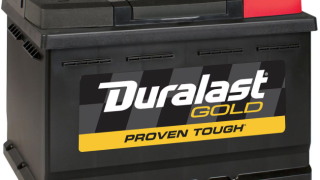
We picked up a Durlas gold battery.
We have
everything wired
temporarily
so we can start this
because I want to hear it
and he wants to hear it, and I know you want to hear it.
So we got it rigged up
safely
so we can start it and we can work out some bugs if it has any.
Now, we don't have a fuel system hooked up,
so I'm gonna use my handy dandy squirt bottle here. I'm gonna fill each bowl up just so it can run for a couple of minutes. We're not gonna run it forever.
We don't have a cooling system hooked up.
We're gonna run it for just a few seconds. It won't hurt anything.
Is that how you fed your guinea pigs in school?
This thing has some pretty big bowls on it.
That's a huge bowl, man.
Now that I've successfully made a huge mess,
there's nothing dangerous about this at all.
I really hope we're not 180 out.
We're about to find out.
Damn right, boys, and it's out of fuel.
Yeah,
is that 47 horsepower?
Probably at idle.
It was firing on all 8.
No, I can't believe it idle the way it did
right off the bat. First start.
Now keep in mind we have not started this prior to this.
This is it.
What you see is what you just got
47 horsepower to over 500
in our '63 Ford Falcon Futura.
I'm at a loss for words, man, honestly,
and.
It's 2800 pounds.
Over just over 500 may not sound like a whole lot to some people,
especially in today's world,
but in 2800 pounds with the 5 speed behind it,
it's gonna be fun.
You know, we still have some other things to do.
We still
got exhaust to do,
interior on this car,
cooling system,
fuel system up and coming,
but once we get it done,
straight to the track is going,
and we're gonna let her rip.
Speaking of let her rip, can we start it again?
Let's go. I wanna do it now.
Today we were able to button the car up just enough to get it to start.
Before anybody freaks out, it's a quarter inch drive
impact driver
drill,
whatever
it's like maybe 20 ft pounds, it's OK.
Not everything was a plug and play,
but once we got it all together,
we were able to make it all work, and now we're rocking over 500 horse with a 5 speed manual.
Woo!
Go baby.
Oh, I can't wait to drive it.
I'm driving it home tonight.
Show Full Transcript
If I'm on fire, there's a big problem.
Today on Blacktop Speed Shop,
we're finishing up our transmission and getting everything hooked up so we could try and run our 363 small block
and our Ford Falcon Futura.
Oh yeah, this is gonna be great. I could see this already.
This engine and trans may not fit in this Ford,
but with a little bit of elbow grease and some luck,
we may just be able to make it work.
Can we get everything dropped in so we can finally say we gained over 500 horsepower?
This is our 1963 Ford Falcon Futura.
When we pulled it in the shop,
it was in such good condition
you'd think this bird could fly,
but a quick look under the hood revealed that this was never going to be fast enough to lift off.
With a tiny 144 inline six,
we wanted to see what it would run on the dyno and if it was indeed the weakest engine if we've ever pulled.
Yeah,
47.29,
79.5 pound feet.
We tried to free up some horsepower,
but somebody decided to make it
too free.
Hey,
uh,
that's what I was gonna tell you.
So we added
500+ horse
with a 363 small block and gave this Falcon a real set of wings.
That's a whole lot of motor for a small car.
That's a huge motor.
I guess we could lower the car down some more
and put this block under the front of it.
How far can we go before the control arms set?
Maybe 3 or 4 inches.
Squeezing all that power under the hood wasn't easy, but we got it to fit, and today this engine is gonna run.
The next step to moving forward with our Falcon is putting the engine back in.
In order to do that, we have to install the clutch so we can put the trans on it,
get the drivetrain mocked up,
and get it ready.
So the biggest difference between these two is that this is a twin disc and this is a single disc.
Twin discs are great when you need
twin disc clamping,
but we don't need that because we're not drag racing. The car's not heavy.
So we went with a single disc aluminum flywheel
to reduce weight
and to make it simpler.
Also,
single discs are a little bit cheaper as well.
The biggest downfall
with this is that
the single discs are a metallic puck style where the twin disc is an organic fiber style which has a little more give to it than these,
so.
This clutch is gonna feel more like an on-off switch than the twin disc,
but
this is a lot lighter and a lot better for spirited street driving,
if you will,
than it is for a twin disc.
But since for this application we don't make the torque and we don't have a super heavy car, we're gonna stick with a single disc
and we're gonna use an aluminum flywheel.
So
this is what we're gonna go with.
Oh.
Big mistake number one, don't forget this.
I totally haven't forgotten this already, I promise
this is.
This is all part of the plan.
This is for manual transmissions. If you don't have this on,
the bottom of this is wide open.
You can get dirt, debris,
your fingers stuck in it while the flywheel's spinning.
That's not good.
We're using this aluminum flywheel that we got from SummitRacing.
Your flywheel here,
one of these bolts will be spaced differently from the rest of them,
so if you put it on and something's not lining up,
don't freak out,
just spin it a couple of times, it'll line up, I promise.
Now that I got the flywheel sitting up here,
we have to install the bolts, and this is your Summit Tech tip.
Before you install the bolts, you have to put Teflon tape
and you have to put ARP lube under the head of the bolt.
So I'm gonna get this one screwed in for you and I'm gonna show you how to do that on the last one here.
Super simple, super easy, but it is necessary.
When you Teflon a bolt,
it's directional,
so you wanna lay it on,
it's gonna feel backwards at first
and you just roll it onto the bolt.
You don't need a lot,
just a couple layers.
Enough so that oil can't get through.
And leak out of your bolts, and then you just.
Rip it off
And then the loose end
here
goes with the threads
so that when you tighten it,
it just tightens it down onto the threads more, it doesn't roll it up,
doesn't ruin anything.
That's a good way to test it if you did it the right way or not.
Just hold your finger on it, screw it like you're tightening,
righty tighty,
and nothing balls up.
You did it right.
Before you do install the bolt, you have to put a little lube under
the head of the bolt.
The bolt should go in smooth
You just want to get them started.
These bolts
go into an oil gallery in the back of the crank,
so if you don't seal the ends of the threads,
it'll leak oil out from right here.
And if you get oil on your friction surface, your clutch will slive, you junk everything,
not good.
So
seal it up good.
Boom, it's broken.
It's gone.
In a star pattern.
You're a star in my eyes.
One.
2.
3.
Or
I
6,
hooray.
Am I done now, sir?
Yeah.
You are done,
sir.
Thank you.
Would you like for me to go fetch you some brake clean,
please? I'll be in my trailer.
I have to go next door because we're out.
Up next
we finished mounting the transmission
and we're gonna see if this TKX is gonna fit.
Now that we've got the flywheel installed, I got the bell housing put on, I got the clutch put on,
we're getting ready to make up our transmission.
Before you put your transmission in,
you have to measure and make sure your spacing for your throw-out bearing is correct.
When you buy a trans from American Powertrain, they send you pretty in-depth instructions. I'm gonna kind of gloss over this and give you some
general information on when you're doing this.
But
it's pretty simple, it's pretty straightforward.
It's nothing hard.
With the instructions for American Powertrains TKX, it tells you
the shim spacing for your throwout bearing. It tells you what each one is, it tells you the math equation you gotta use, which you just subtract your numbers. It's nothing crazy.
You want to get at least 3 measurements to get a median, that way you can have an average
in case one finger is different from another one.
Same thing with your throw-out bearing.
You measure from the face of the throwout bearing
to the face of the transmission itself.
You do 3 measurements in 3 different places to get a median.
When you get those,
American Powertrain tells you
to take
the one from the transmission
and subtract it from the one from the bell housing.
They even give you
an example
to help you.
American powertrains spec for the air gap
is no less than 100,000 and no more than 200,000. They say they want it at about 150,000 of an inch.
Our math,
which I have
wrote down
right here,
came out to 151,000 with 4 of their shims.
Each of their shims is 57,000 thick, which they put in here.
This is what it looks like.
Since we're putting this in a Ford,
we ordered a Ford throw hydraulic throwout bearing kit. They call it the,
the Hydromax throwout bearing kit from American Powertrain. That's for a Ford.
So when you get your measurements for your clutch to your bell housing and from the trans to your throwout bearing, you got to subtract them and that gives you a number.
Ours was 379,000.
American Powertrain tells you to subtract the.
Thickness of your shim
as many times as it takes to get between 100,000
and 200,000.
For us that was 4, and that left us with 151,000 of an inch for air gap,
which is right in the middle of the spec where they want it.
But now that we're in spec
and we're getting ready to put it in the car,
I need
Brian
to come help me make these two together and we'll go drop it in the car and
Maybe start it.
Hopefully,
if Dad lets me,
we'll start a.
Make sure you pull your alignment tool before you try to put the input shaft in though
it's a good rule of thumb.
That probably wouldn't work very well,
no.
Man, I wish they made like a, a jack for this.
What they say like a bull in a china shop
or a long-tailed cat in a room full of rocking chairs.
Do Southerners say anything that makes sense?
Hold on,
I'll put this bowl in, Jackson.
So it should already be lined up.
Look at that, dude.
Well, we got a problem.
No pressure.
What's the problem is if it's not
lined up right now and it's sitting in there like that,
we have a problem.
Should we put thread locker on this?
I did in the bell housing. I don't know about these.
Guess we can
later.
Later,
later,
when it comes off,
that'll happen
100%. That'll happen. I think it'll be just fine without it, dude.
What's the torch spec, you know.
That much that much sounds good.
I figured aluminum to aluminum would be 45.
Or I just ruined it and it's gonna blow up now it's gonna explode,
it's gonna spontaneously combust because I over torqued it.
So this is
a thing of beauty,
yeah,
because it's a 5 speed and it's complete,
not a slush box
as much as we can complete it up to this point.
So while we had the engine and transmission already out of our Ford Falcon,
we wanted to dress up the engine bay as much as we could.
Uh, we really thought about leaving the traditional black like.
Most cars come from the factory,
but we wanted something a little different.
So
interior on our car is Ford Rangoon red, which is a common color for a sixties model Ford.
So we wanted to dress it up and we painted the engine bay that color.
Couple things to note though with that color.
Uh,
the inside of the vehicle is all red, red dash carpet seats,
door panels,
everything,
and the windows are currently tinted on this car as well,
so it makes the red look more dark than what it really is once the door opens.
So I did a spray out panel,
some scrap metal that we had around the shop.
The red is still gonna be red, but you could change the lightness or darkness of the color
by the base.
You put it over
so
this side
right is the white side,
this side is the gray side, and there's a black strip that's separating it down the middle.
Well now our paint's in
everything is dry,
everything is cured, um, now we're ready to sit the engine and transmission in it, but
we gotta be extremely careful not to scratch and tear up our brand new paint job in here,
so it's gonna be a task for two people for sure.
Hold on, we're,
we're slipping,
careful,
that leg just lifted a little bit.
All right, hold it right there,
Kemosabe.
It's like wasabi but different.
Oh yeah, this is gonna be great. I can see this already.
All right,
stop right there.
Can you start to let it down a little bit,
keep going.
I wonder how much fluid's gonna leak out of this transmission if I pull this yoke out.
Probably a lot.
I'm just giving the action cam
a bath.
Oh yeah.
Yeah, it's great.
Somebody planned that out really well.
We never remember
to drain the transmission.
One day we'll learn,
but that day ain't today.
So instead we're gonna do some natural rust prevention.
It's steady puking.
Oh God.
Don't worry, the yolk's puking out too.
Oh,
my gloves filling up as we speak.
This is what two guys would do in their garage though,
make a mess.
If you're putting a new transmission on, usually it's not full of oil.
Well,
it's just idiots. It is backwards. It's new,
new to us transmission.
Can it angle anymore?
Is that all it's got?
Where's your gun at?
I got you on there.
Which one angles it more, righty tight here, lefty loosey? I think it's
right.
Coming up
is back to square one as we change gears on our trans install.
All right, so
par for the course for us in the Falcon project, we've run into another issue.
Uh, we're trying to make or try to put the engine and transmission in together as one.
Uh, we don't have enough angle on the dangle to get it to Dolphin enough to go underneath
the transmission tunnel, so
at this point we're gonna have to split it.
So we'll pull the transmission off,
leave the bell housing attached.
We know our spines and everything are good,
so it should go right back in and we'll just install it from underneath the car.
Uh, not ideal,
but we don't want to scratch up our paint and tear up anything either,
so.
Change of plans.
Why do it once when you can do it twice? Correct?
Can you
never mind.
Oh,
is it in gear?
Can you ungear it?
Neutrale neutralis,
I guess I could put the yolk back in here too,
make it easier to turn.
No, it's fine. I already got it.
Don't worry about it now.
So, uh,
The old throw out bearings on your side.
I can hold
this steady while you slip that back on.
Uh,
I'll have to get out
because I won't be able to reach it from over here.
Which way do you hold it to go steady?
I'll hold it back here.
OK.
I gotta get out anyway.
Do you wanna put the throw out bearing on it since I had the tail shaft of the transmission?
I don't care.
That way I've already got it.
OK,
that'd probably be easier.
We worked in a gravel driveway.
Me too.
All right,
now.
This time.
Slow,
yeah,
yep,
just a little bit.
A little more.
Put it on the right way.
It won't do that.
You have to go backwards. Yeah,
yep.
Hold on, hold on
which way you need to go? I don't know.
It's just, I'm on it. I just gotta line that O-ring up and it's,
it's fragile, so you can't just rip it.
I got a window
in the side of the bell housing that's the perfect size
of my hand.
Ain't that crazy if it's so tight in there like that?
Yeah,
it's ridiculous, honestly.
The side of this bell housing needs a window that's like
a half inch wider.
Put a manual in it.
It's a great idea. It'd be fun.
Put a manual in it. Let's put that Ford Amatic from 1960 in there.
Easy.
Got it.
Whatever you do,
push really hard,
pull it back out.
I think,
yeah, you're lined up too,
you jack it straight up and it should,
it should just slip right in.
I'll try to hold the throat bearing on without
smashing my finger.
Silly fluid.
You're supposed to stay inside the transmission.
That them holes are lined up
back here.
Now go back to where you were.
There we go.
Ta da
I don't think it's gonna go more than that.
No, that's good though.
Up next,
can we take this Falcon from 50 to over 500 horsepower,
or is it going back to the drawing board?
Well, we're finally here.
It's finally time
to see what our hard work has done,
you know, up to this point
we've got our engine installed,
our transmissions installed,
everything is hooked up,
definitely not the final look that we're going for,
but
we want to fire the engine
because we can.
Now it wasn't easy stuffing this in here.
Being a small car, we had to split the.
Trans from the engine. We had to put the engine in first,
get under it on our backs,
make a huge mess,
put the trans in from the bottom.
After we got those in,
we had to lift the engine back up to shove the headers in.
Even though they're low profile headers, there's still not much room.
We went to AutoZone.
We picked up a Durlas gold battery.
We have
everything wired
temporarily
so we can start this
because I want to hear it
and he wants to hear it, and I know you want to hear it.
So we got it rigged up
safely
so we can start it and we can work out some bugs if it has any.
Now, we don't have a fuel system hooked up,
so I'm gonna use my handy dandy squirt bottle here. I'm gonna fill each bowl up just so it can run for a couple of minutes. We're not gonna run it forever.
We don't have a cooling system hooked up.
We're gonna run it for just a few seconds. It won't hurt anything.
Is that how you fed your guinea pigs in school?
This thing has some pretty big bowls on it.
That's a huge bowl, man.
Now that I've successfully made a huge mess,
there's nothing dangerous about this at all.
I really hope we're not 180 out.
We're about to find out.
Damn right, boys, and it's out of fuel.
Yeah,
is that 47 horsepower?
Probably at idle.
It was firing on all 8.
No, I can't believe it idle the way it did
right off the bat. First start.
Now keep in mind we have not started this prior to this.
This is it.
What you see is what you just got
47 horsepower to over 500
in our '63 Ford Falcon Futura.
I'm at a loss for words, man, honestly,
and.
It's 2800 pounds.
Over just over 500 may not sound like a whole lot to some people,
especially in today's world,
but in 2800 pounds with the 5 speed behind it,
it's gonna be fun.
You know, we still have some other things to do.
We still
got exhaust to do,
interior on this car,
cooling system,
fuel system up and coming,
but once we get it done,
straight to the track is going,
and we're gonna let her rip.
Speaking of let her rip, can we start it again?
Let's go. I wanna do it now.
Today we were able to button the car up just enough to get it to start.
Before anybody freaks out, it's a quarter inch drive
impact driver
drill,
whatever
it's like maybe 20 ft pounds, it's OK.
Not everything was a plug and play,
but once we got it all together,
we were able to make it all work, and now we're rocking over 500 horse with a 5 speed manual.
Woo!
Go baby.
Oh, I can't wait to drive it.
I'm driving it home tonight.